What Is a SaaS Business Model?
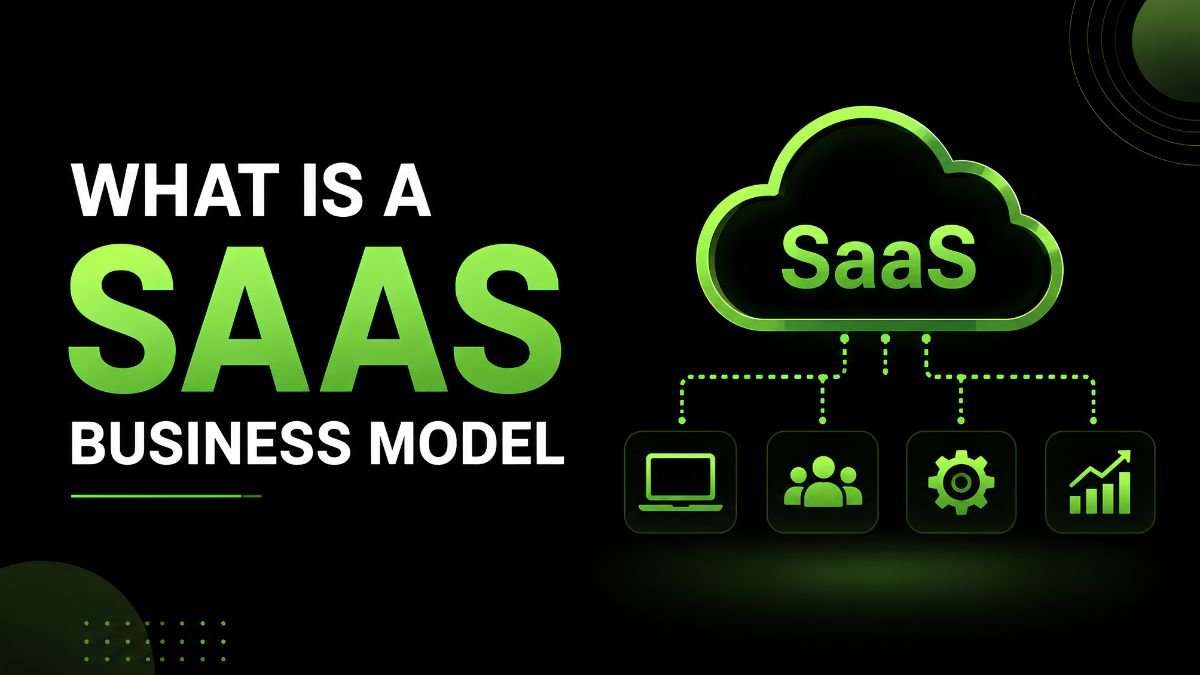
A SaaS business model lets you use software through the internet instead of buying and installing it on your own computer.
SaaS stands for Software as a Service. In this model, a company creates and hosts software for its customers. Customers then access the software online. They often pay a monthly or yearly fee.
For example, tools for email marketing, project management, accounting, CRM, design, and team chat often use the SaaS model.
The SaaS model has become a major part of the software market. Gartner reports that the worldwide enterprise SaaS market reached $218.5 billion in 2024, up 16.7% from the year before.
But how does this model work? How do SaaS companies make money? And what makes a SaaS business successful?
Let’s look at each part.
What Is a SaaS Business Model?
A SaaS business model is a way to sell software as an online service. Instead of selling software as a one-time product, a SaaS company gives customers ongoing access to the software. The company hosts the software and takes care of much of the technical work.
You usually access SaaS software through a web browser or app.
For example, imagine that you need a tool to manage your team’s projects.
With traditional software, you may need to:
- Buy a software license.
- Download the software.
- Install it on your computer.
- Pay for major upgrades.
- Manage some parts of the software yourself.
With SaaS, you usually:
- Visit the software website.
- Create an account.
- Choose a plan.
- Log in.
- Use the software online.
A SaaS company handles the main software infrastructure. AWS describes SaaS as a cloud software model where vendors host applications and let customers access them on demand. SaaS products often use subscription or pay-as-you-use pricing.
How Does the SaaS Business Model Work?
The SaaS model follows a simple cycle:
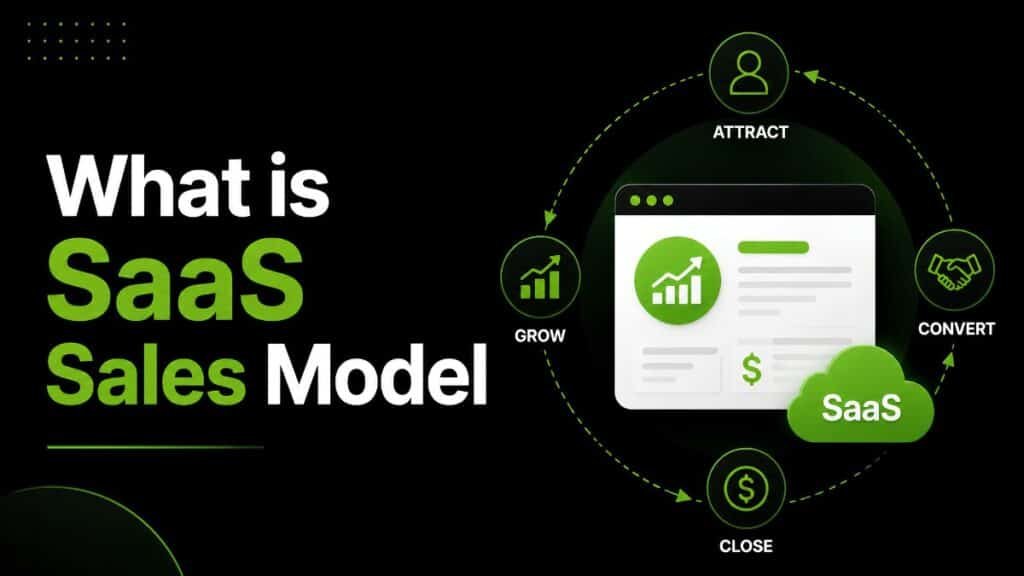
Build software → attract users → convert users into customers → deliver value → retain customers → grow revenue
Here is how each step works.
1. A SaaS Company Finds a Problem
A SaaS company starts with a problem. For example, a business may struggle to:
- Track sales leads.
- Manage employees.
- Send email campaigns.
- Create invoices.
- Store files.
- Manage projects.
- Talk with remote teams.
The SaaS company builds software to solve that problem.
2. The Company Builds the Software
The company creates a software product around the problem. The product can include:
- Web app
- Mobile app
- Online dashboard
- User accounts
- Data storage
- Reports
- Integrations
- Automation tools
The company may start with a small version called an MVP, or minimum viable product. The goal is simple. Solve the main problem first.
3. The Company Hosts the Software
The SaaS company hosts the software on cloud infrastructure.
Customers do not need to manage the main servers. They simply access the service through the internet.
The company takes care of many technical tasks, such as:
- Software updates
- Server management
- Data storage
- Security controls
- System monitoring
- Backups
- Performance
The exact setup varies from one SaaS company to another.
4. The Company Gets Customers
A SaaS company needs customers to grow. It uses a SaaS sales model to find recurring customers.
Common channels to get customers for SaaS include:
- SEO for SaaS
- Content marketing
- Social media
- Paid advertising
- Email marketing
- Sales teams
- Referrals
- Partnerships
- Free trials
- Product demos
A SaaS company may also offer a free plan. This can help people try the product before they pay.
5. Customers Pay for Access
Once a customer sees enough value, they can choose a paid plan. The company may charge:
- Per month
- Per year
- Per user
- Per account
- Based on usage
- Based on features
- Through a custom enterprise contract
The pricing model depends on the product and its customers.
6. The Company Keeps Customers
Getting a customer is only one part of the SaaS model. The company also needs to keep that customer. This process is called customer retention.
A SaaS company can improve retention by offering:
- Easy onboarding
- Useful features
- Fast support
- Good product performance
- Regular improvements
- Helpful training
- Strong customer service
If customers stop using the product, they may cancel their plans. This creates churn.
7. The Company Expands Revenue
A SaaS company can also make more money from existing customers. For example, a customer may:
- Add more users.
- Move to a higher plan.
- Buy extra features.
- Increase usage.
- Add another product.
This creates expansion revenue.
How Do SaaS Companies Make Money?
Most SaaS companies use recurring or usage-based revenue models. The main options include the following.
Subscription Revenue
Customers pay a recurring fee.
For example:
- $10 per month
- $100 per year
- $50 per user each month
The customer keeps access while the subscription remains active.
Subscription revenue gives a SaaS company a recurring revenue stream. However, the company still needs to account for cancellations, downgrades, and other changes.
Usage-Based Revenue
Customers pay according to how much they use the product.
For example, a company may charge based on:
- API calls
- Storage
- Messages
- Transactions
- Data processed
- Compute use
AWS Marketplace also supports SaaS models where the seller tracks customer usage and charges based on that usage.
Per-User Pricing
The customer pays for each user. For example, a software company may charge $20 per user each month. If a team has 10 users, the customer pays for 10 seats.
Tiered Pricing
Tiered pricing helps a SaaS company serve customers with different needs. Each tier has a different price. The company creates several plans.
For example:
| Plan | Target customer | Typical features |
|---|---|---|
| Basic | Small users | Core features |
| Pro | Growing teams | More features |
| Business | Larger teams | Advanced tools |
| Enterprise | Large companies | Custom features and support |
Freemium Pricing
The company offers a basic version for free. Users can then pay for more features.
For example, the free plan may have:
- Fewer users
- Less storage
- Basic features
- Limited support
The paid plans can offer more.
Hybrid Pricing
Some SaaS companies mix several pricing models. For example, a company may charge:
- A base subscription
- A fee for each user
- An extra fee for high usage
AWS Marketplace also supports SaaS contracts with additional pay-as-you-go usage.
What Are the Main SaaS Pricing Models?
There is no single pricing model that works for every SaaS company. The right model depends on how customers use the product.
| Pricing model | How it works | Example use |
|---|---|---|
| Flat-rate | One fixed price | Simple software |
| Tiered | Several plans | Business software |
| Per-user | Price changes with users | Team software |
| Usage-based | Price changes with usage | APIs and cloud tools |
| Freemium | Free plan plus paid plans | Consumer and product-led SaaS |
| Hybrid | Combines two or more models | Complex SaaS products |
The key goal remains the same: match price with the value customers receive. A SaaS company should not choose a pricing model only because another company uses it.
What Are the Main Parts of a SaaS Business Model?
A SaaS business model has several connected parts.
Target Customer
First, the company needs to know who it serves. The target customer may be:
- An individual
- A small business
- Large business
- Enterprise
A clear target helps the company build a better product and message.
Value Proposition
The value proposition answers one basic question: Why should someone use this software?
A strong SaaS product solves a real problem. It may help customers:
- Save time
- Reduce costs
- Make more money
- Reduce errors
- Automate work
- Improve communication
- Make better decisions
Product
The product forms the core of the SaaS business. It must do the job customers expect. The product also needs to remain useful as customer needs change.
Distribution
The company needs a way to reach customers. It may use:
- Search engines
- Sales teams
- Ads
- Social media
- Partners
- Referrals
- Product-led growth
Revenue
The company needs a clear way to charge customers. It may use subscriptions, usage-based pricing, per-user pricing, or a mix.
Retention
Customers need a reason to stay. This makes retention one of the most important parts of the SaaS model.
Cost Structure
A SaaS company also has costs. These can include:
- Product development
- Employee salaries
- Cloud infrastructure
- Sales
- Marketing
- Customer support
- Security
- Compliance
- Software tools
Revenue alone does not tell you if a SaaS company has a healthy business.
What Are the Types of SaaS Business Models?
SaaS companies can serve different markets.
B2B SaaS
B2B SaaS means business-to-business software. The B2B SaaS company sells software to other businesses.
Common examples include:
- CRM software
- Accounting software
- HR software
- Project management software
- Marketing software
- Business analytics software
B2B SaaS often has longer sales cycles and larger contracts.
B2C SaaS
B2C SaaS means business-to-consumer software. The company sells directly to individual users.
Examples can include:
- Personal productivity tools
- Design software
- Learning tools
- Personal finance apps
B2C SaaS often focuses on easy sign-up and simple pricing.
Vertical SaaS
Vertical SaaS serves one specific industry. For example, a company may build software only for:
- Dentists
- Hotels
- Real estate firms
- Construction companies
- Law firms
- Medical clinics
The product can solve very specific industry problems.
Horizontal SaaS
Horizontal SaaS serves customers across many industries. For example, a project management tool can serve:
- Marketing teams
- Software companies
- Schools
- Agencies
- Retail businesses
The product solves a broad business problem.
Enterprise SaaS
Enterprise SaaS targets large organizations. These customers often need:
- Advanced security
- User controls
- Detailed reports
- Custom integrations
- Compliance support
- Large-scale performance
- Dedicated customer support
Enterprise customers may also sign large contracts.
Micro-SaaS
A micro-SaaS product serves a small and focused market. It may solve one narrow problem.
For example, a small SaaS product may help Shopify store owners automate one task. A micro-SaaS business can have a small team and a focused product.
Most Important SaaS Metrics
SaaS companies use metrics to understand business health. These metrics help answer questions such as:
- Are we gaining customers?
- Are customers staying?
- Are we making more recurring revenue?
- Does customer growth make financial sense?
Stripe groups SaaS metrics into areas such as acquisition, engagement, retention, growth, and business economics.
Here are the main metrics you should know.
Monthly Recurring Revenue (MRR)
MRR measures recurring revenue expected each month. For a simple example, imagine 100 customers each pay $50 per month.
Your MRR would be: 100 × $50 = $5,000
MRR does not include one-time payments.
Stripe describes MRR as the monthly recurring revenue a business can expect from active subscriptions.
Annual Recurring Revenue (ARR)
ARR shows recurring revenue on an annual basis. A simple calculation uses MRR multiplied by 12.
For example: $5,000 MRR × 12 = $60,000 ARR
ARR gives a longer view of recurring revenue. However, ARR does not equal total accounting revenue or profit. It also does not include every type of one-time income.
Customer Acquisition Cost (CAC)
CAC tells you how much it costs to gain a new customer. For example, if you spend $10,000 on sales and marketing and gain 100 customers: CAC = $10,000 ÷ 100 = $100
A SaaS company wants to keep CAC at a level that makes sense for its customer value.
Customer Lifetime Value (LTV)
LTV estimates how much value a customer can bring during the customer relationship.
A customer who pays $100 each month for two years has generated $2,400 in subscription payments before costs.
LTV helps a company compare customer value with acquisition cost.
Churn Rate
Churn measures customers or revenue that a business loses.
For example, if you start a month with 100 customers and five cancel, your customer churn rate is 5% for that period.
High churn can hurt SaaS growth because the company needs to replace lost customers.
Net Revenue Retention (NRR)
NRR looks at revenue from existing customers.
It considers:
- Expansion
- Upgrades
- Downgrades
- Cancellations
An NRR above 100% means existing customers generated more revenue than they did at the start of the period, after those changes.
Gross Margin
Gross margin shows how much revenue remains after direct costs. A SaaS company needs enough gross margin to cover other costs, such as:
- Sales
- Marketing
- Product development
- Administration
LTV to CAC Ratio
This metric compares customer value with customer acquisition cost.
For example, if a customer’s LTV equals $3,000 and CAC equals $1,000: LTV:CAC = 3:1
Stripe notes that SaaS companies often use a 3:1 LTV to CAC ratio as a general target. However, the right level can vary by company, market, and stage.
Why Is Customer Retention So Important in SaaS?
Retention matters because SaaS revenue depends on ongoing customer relationships.
Imagine a SaaS company gets 1,000 customers.
If many customers cancel each month, the company must keep finding new customers just to maintain its customer base.
Now imagine that most customers stay.
The company can then focus more on:
- Finding new customers
- Helping current customers
- Selling higher plans
- Adding new products
This creates a stronger growth loop.
That is why SaaS companies track churn, retention, and expansion along with new customer growth.
SaaS Business Model vs Subscription Business Model
People often use these terms as if they mean the same thing.
They do not.
- SaaS describes software delivery.
- Subscription describes a payment method.
A SaaS company often uses subscriptions, but the two ideas remain different.
For example, a SaaS company can use:
- Monthly subscriptions
- Annual subscriptions
- Usage-based pricing
- Per-user pricing
- Freemium pricing
- Hybrid pricing
AWS also lists subscription, contract, contract-plus-usage, and free SaaS pricing options in its marketplace.
So, not every subscription business is SaaS.
A streaming membership and a SaaS product can both use recurring payments. But only the SaaS product provides software as the main service.
SaaS vs Traditional Software
The biggest difference comes from how customers access and pay for the software.
| Feature | SaaS | Traditional software |
|---|---|---|
| Delivery | Online service | Local software |
| Access | Usually online | Often installed |
| Payment | Often recurring | Often one-time |
| Updates | Usually handled by provider | May require manual updates |
| Hosting | Provider usually hosts it | Customer may host it |
| Maintenance | Provider handles much of it | Customer may handle more |
| Revenue | Recurring or usage-based | Often license sales |
The lines can blur today.
Some traditional software now uses cloud delivery and subscriptions. So, you should judge the model based on how the software gets delivered, managed, and sold.
Is the SaaS Business Model Profitable?
Yes, a SaaS business can become profitable. But SaaS does not mean profit.
A company may have high recurring revenue and still lose money. For example, a SaaS company may spend heavily on:
- Product development
- Sales
- Marketing
- Employees
- Cloud infrastructure
- Customer support
A young company may spend more money to gain customers and build the product.
Over time, the company may improve its economics through:
- Better customer retention
- Lower CAC
- Higher customer value
- Better pricing
- More efficient operations
- Expansion revenue
This is why you should not judge a SaaS company by revenue alone.
Look at revenue, growth, churn, retention, CAC, LTV, gross margin, and cash needs together.
How to Start a SaaS Business
If you want to build a SaaS business, start with the problem rather than the software.
Step 1: Find a Clear Problem
Find a problem that people already face. Talk to potential customers.
- Ask what they do now.
- Ask what makes the task hard.
Step 2: Define Your Customer
Do not try to serve everyone. Choose a clear customer group.
For example:
Small accounting firms that need simple client management software.
This gives you a much clearer starting point.
Step 3: Validate the Idea
Before you build a large product, test the idea.
You can:
- Interview customers.
- Study competitors.
- Build a simple landing page.
- Create a prototype.
- Offer a small paid service.
- Test demand.
The goal is to learn if people care about the problem.
Step 4: Build an MVP
Build the smallest product that can solve the main problem. Do not add every feature at the start. Start with the core value.
Step 5: Choose a Pricing Model
Choose pricing based on customer value and product use.
You can test:
- Flat pricing
- Tiered pricing
- Per-user pricing
- Usage-based pricing
- Freemium
- Hybrid pricing
Do not assume that a free plan always works best.
Step 6: Launch the Product
Get your first users. Watch how they use the product.
Listen to their feedback. Look for points where users stop or get confused.
Step 7: Track SaaS Metrics
Track metrics such as:
- MRR
- ARR
- CAC
- LTV
- Churn
- Retention
- NRR
- Gross margin
You do not need dozens of metrics. Focus on the numbers that help you make better decisions.
Step 8: Improve Retention
Find out why customers leave. Then fix the problems that matter most. Better retention can improve the value of each customer.
Step 9: Scale Customer Acquisition
Once the product works well for a clear market, increase your best acquisition channels. Do not scale a broken product too early.
Step 10: Expand the Business
Once the core product works, you can add:
- New features
- Higher plans
- New customer groups
- New markets
- Add-on products
- Integrations
Grow when customers have a clear need for more.
Common SaaS Business Model Mistakes
SaaS companies can make many mistakes. Here are some of the most common.
Building Before Validating
A company may spend months building software that nobody wants. Talk to customers before you invest too much.
Targeting Everyone
A product for everyone can become a product for no one. Start with a clear audience.
Adding Too Many Features
More features do not always mean more value. Build around the main customer problem.
Ignoring Churn
A company may focus only on new sales. But customers can leave just as quickly. Track why customers cancel.
Using the Wrong Pricing Model
Your pricing should match how customers receive value. For example, usage-based pricing may make more sense for some products than per-user pricing.
Making Onboarding Hard
Users should understand how to start. Remove steps that do not help them reach value.
Focusing Only on Revenue
Revenue matters. But revenue alone cannot tell you if the business model works. Track customer acquisition, retention, costs, and margins too.
Scaling Too Early
More advertising cannot fix a product that customers do not want. First improve the product and customer experience.
Then scale what works.
Takeaway
The SaaS business model turns software into an ongoing service. The model works best when the product solves a real problem and keeps delivering value.
The basic SaaS growth loop looks like this:
Solve a problem → attract users → convert customers → deliver value → retain customers → expand revenue
The most important point is simple.
A SaaS company does not win by selling software once. It wins by giving customers a reason to keep using the software.
Frequently Asked Questions
What is a SaaS business model in simple terms?
A SaaS business model lets customers use software through the internet. The SaaS company hosts and manages the software. Customers usually pay a recurring fee or pay based on usage.
How does a SaaS company make money?
A SaaS company can make money through subscriptions, usage-based fees, per-user pricing, tiered plans, enterprise contracts, and add-ons. Some companies also use freemium plans to attract users and convert some of them into paying customers.
Is SaaS the same as a subscription business?
No. SaaS describes software delivered as an online service. A subscription describes a way to charge customers. SaaS companies often use subscriptions, but they can also use usage-based or hybrid pricing.
What are the main SaaS revenue models?
The main SaaS revenue models include subscription, per-user, usage-based, tiered, freemium, enterprise, and hybrid models.
What is MRR in SaaS?
MRR means Monthly Recurring Revenue. It measures the recurring revenue a SaaS business expects to receive each month from its active subscriptions. It does not normally include one-time payments.
What is ARR in SaaS?
ARR means Annual Recurring Revenue. It gives a yearly view of recurring revenue. A simple way to estimate it is to multiply MRR by 12. However, ARR does not represent total accounting revenue or profit.
What is SaaS churn?
SaaS churn measures customers or recurring revenue that a company loses over a set period.
For example, if 5 out of 100 customers cancel during a period, the customer churn rate would be 5% for that period.
What is CAC in SaaS?
CAC means Customer Acquisition Cost. It shows how much a company spends to gain a new customer.
It can include sales and marketing costs.
What is LTV in SaaS?
LTV means Customer Lifetime Value. It estimates how much value a company can receive from a customer during the customer’s relationship with the business.
Is SaaS profitable?
A SaaS business can be profitable, but the model does not guarantee profit. Profit depends on factors such as pricing, customer retention, customer acquisition cost, gross margin, operating costs, and growth.
What are examples of SaaS businesses?
Examples include Salesforce, HubSpot, Slack, Shopify, and Adobe Creative Cloud. These companies provide software through online services and use recurring or other ongoing revenue models.